INShAck 2019 :: You Shall Not Pass :: Forensics 330 Writeup
Challenge details.
| Category | Points | Solves |
|---|---|---|
| Forensics | 330 | 11 |
1. Challenge description
One of my friends is a show-off and I don’t like that. Help me find the backdoor he just boasted about! :DYou’ll find an image of his USB key here.And one last thing, my friend owns
you-shall-not-pass.ctf.insecurity-insa.fr.
2. Solution
2.1 Data Extraction Part
By extracting the compressed file that was given to us, we find a raw image of an NTFS filesystem, you can verify that using the file command on linux. (probably made with dd considering the filename :D )
file dd.img
result of the file command is shown below.

First I tried to mount the filesystem and see what we’ve got inside. (first you create a folder /mnt/you_shall_not_pass), then mount the image using the mount command on linux.
sudo mount -o loop -t ntfs dd.img /mnt/you_shall_not_pass
After mounting the filesystem, We got a bunch of weird folders & files, majority of them were text files containing some Bacon Ipsum (not really important) and one MP4 video file, the video file contained a scene from LOTR (Lord Of The Ring) movie (That was a good scene, where Gandalf says "YOU SHALL NOT PAAASSSSS!").
Well, let’s start the work, I watched the video, read the texts with no progress at all, then i said let’s check the filesystem for some hidden files or hidden strings, I first tried the strings command, didn’t help much. Then I tried to do tail on the filesystem, after doing tail on the image, something caught my EYE :D, which looks like a Base64 encoded string.
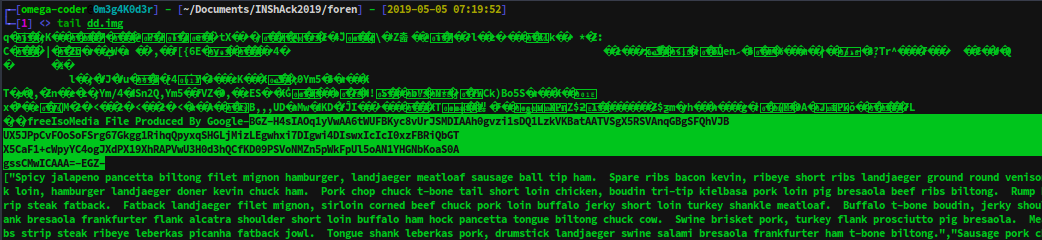
H4sIAOq1yVwAA6tWUFBKyc8vUrJSMDIAAh0gvzi1sDQ1LzkVKBatAATVSgX5RSVAnqGBgSFQhVJB
UX5JPpCvFOoSoFSrg67Gkgg1RihqQpyxqSHGLjMizLEgwhxi7DIgwi4DIswxIcIcI0xzFBRiQbGT
X5CaF1+cWpyYC4ogJXdPX19XhRAPVwU3H0d3hQCfKD09PSVoNMZn5pWkFpUl5oAN1YHGNbKoaS0A
gssCMwICAAA=
It starts with BGZ and ends with EGZ !,well i guessed that right away, it’s a gzip compressed file.
let’s decode the base64 and see whats inside the file,
echo "H4sIAOq1yVwAA6tWUFBKyc8vUrJSMDIAAh0gvzi1sDQ1LzkVKBatAATVSgX5RSVAnqGBgSFQhVJB
UX5JPpCvFOoSoFSrg67Gkgg1RihqQpyxqSHGLjMizLEgwhxi7DIgwi4DIswxIcIcI0xzFBRiQbGT
X5CaF1+cWpyYC4ogJXdPX19XhRAPVwU3H0d3hQCfKD09PSVoNMZn5pWkFpUl5oAN1YHGNbKoaS0A
gssCMwICAAA=" | base64 -d > file.gz
Let’s unzip the file using gunzip comamnd, and make sure you have .gz file extension.
gunzip file.gz
You will get in result a file named file.tar, but its just a text file, not a tar archive, you can verify it using the file command.
here is the content of the file.tar
{
    "door": 20000,
    "sequence": [{
        "port": 10010,
        "proto": "UDP"
    }, {
        "port": 10090,
        "proto": "UDP"
    }, {
        "port": 10020,
        "proto": "TCP"
    }, {
        "port": 10010,
        "proto": "UDP"
    }, {
        "port": 10060,
        "proto": "TCP"
    }, {
        "port": 10080,
        "proto": "UDP"
    }, {
        "port": 10010,
        "proto": "UDP"
    }, {
        "port": 10000,
        "proto": "TCP"
    }, {
        "port": 10000,
        "proto": "UDP"
    }, {
        "port": 10040,
        "proto": "TCP"
    }, {
        "port": 10020,
        "proto": "UDP"
    }],
    "open_sesame": "GIMME THE FLAG PLZ...",
    "seq_interval": 10,
    "door_interval": 5
}
2.2 Port Knocking Task
We got a JSON file, it have a bunch of ports and some infos. [seq_interval, door_interval, open_sesame] and door
This is OBVIOUSLY a port knocking task, if you don’t know about port knocking just GOOGLE IT!!
In computer networking,
port knockingis a method of externally openingportson a firewall by generating a connection attempt on a set of prespecifiedclosed ports.
So Basically, we gonna knock the ports in the given sequence according to the protocol in an interval of 10s (this was clarified by the challenge author @Paul) to be able to connect to the service on port 20000 (Our door :D).
Here is my script for doing the port knocking and getting the flag.
It knocks the sequence then connects to service on port 20000, sends the open_sesame string and gets the flag.
#!/usr/bin/env python3

import time
import socket
import select
import json

class Knocker(object):
    def __init__(self, ports_proto: list, delay=400, udp=False, host="127.0.0.1", timeout=200):
        self.timeout = timeout / 1000
        self.delay = delay / 1000
        self.default_udp = udp
        self.ports_proto = ports_proto

        self.address_family, _, _, _, (self.ip_address, _) = socket.getaddrinfo(
                host=host,
                port=None,
                flags=socket.AI_ADDRCONFIG
            )[0]

    def knock_it(self):
        last_index = len(self.ports_proto) - 1
        for i, port in enumerate(self.ports_proto):
            use_udp = self.default_udp
            if port.find(':') != -1:
                port, protocol = port.split(':', 2)
                if protocol == 'TCP':
                    use_udp = False
                elif protocol == 'UDP':
                    use_udp = True
                else:
                    error = 'WTF!'
                    raise ValueError(error.format(protocol))

            s = socket.socket(self.address_family, socket.SOCK_DGRAM if use_udp else socket.SOCK_STREAM)
            s.setblocking(False)

            socket_address = (self.ip_address, int(port))
            if use_udp:
                print("Knocking port {} using UDP".format(port))
                s.sendto(b'', socket_address)
            else:
                print("Knoocking port {} using TCP".format(port))
                s.connect_ex(socket_address)
                select.select([s], [s], [s], self.timeout)

            s.close()

            if self.delay and i != last_index:
                time.sleep(self.delay)


if __name__ == '__main__':
    host = "you-shall-not-pass.ctf.insecurity-insa.fr"
    print("[?] Getting Data ...")
    json_file = open("file.tar", "r")
    data = json.load(json_file)
    open_sesame = data["open_sesame"]
    ports_proto = [str(i["port"])+":"+i["proto"] for i in data["sequence"]]
    print("[+] Knocking Ports now...")
    Knocker(ports_proto, delay=900, host=host).knock_it()
    time.sleep(1)
    print("[?] Asking for Flag ...")
    try:
        s = socket.socket(socket.AF_INET, socket.SOCK_STREAM)
        s.connect((host, int(data["door"])))
    except Exception as e:
        print("[!] CONNECTION FAILED!!!, Port may not be opened")
    else:
        print("[+] DOOR OPENED")
        s.send(open_sesame.encode())
        try:
            flag = s.recv(2014).decode()
            print("Got flag: ", flag)
        except Exception as e:
            print("NOTHING")
    finally:
        s.close()
Here is your FLAG: INSA{213dca08e606ef9e5352f4bdd8b6dd9d6c559e9ce76b674ae3739a34c5c3be37}